




Worlds Largest Ancestry Database

Female Ancestry Test

Maternal Bronze £129.00

  • Discover Deep Ancestry
  • HVR 1 DNA Testing
  • Basic Online Access

Maternal Silver £149.00

  • Discover Deep Ancestry
  • HVR 1 & 2 Testing
  • Find Ancestors Online

Maternal Gold £299.00

  • Discover Deep Ancestry
  • Full mtDNA Sequence
  • Advanced Online Tools

What do the tests give me?

  • 3 Levels of Detail (HVR1, HVR2 & Full mtDNA Sequence)
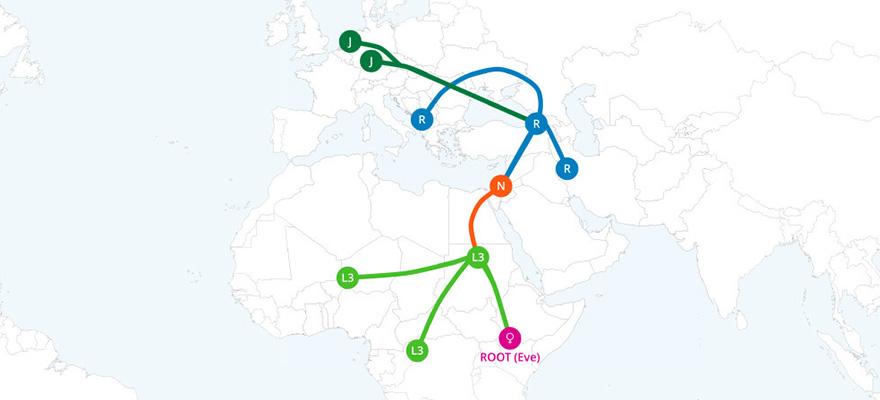
  • Your maternal migration route and detailed Haplogroup
  • Ancestry certificates and simple to understand report
  • Lifetime Access to the world's largest Ancestry Database
  • Online Tools to find relatives with the same DNA
  • Simple Home Collection Kit using a Mouth Swab
  • Your Personal Information and DNA is kept Secure & Private

Explore your Maternal Ancestry Today

Trace the origin of the direct maternal line (mother's mother's mother etc.). mtDNA (mitochondrial DNA) is passed down from mother to child. Men have their mother's mtDNA but do not pass it on to their children.

There are 30 major maternal lineages (haplogroups) that have been identified worldwide.

The mtDNA test determines which one of the 30 maternal lineages they belong to and provides the broad geographic region throughout which the lineage is found (e.g.: Oceania, Africa, Europe, Middle East). Then if possible, further DNA testing is conducted to determine to which of the sub haplogroups (sub areas) you belong.

Who can take this test and how long does it take?

Anyone can take the mtDNA test. The test takes 6-8 weeks and comes with a detailed report showing your mtDNA haplogroup and full online access to our database allowing you to find relatives around the world that share the same DNA.

FAQs

How much detail does the maternal ancestry test provide?

For the mtDNA maternal ancestry test, the amount of ancestral information that can be revealed depends on how unique your DNA Code is. An individual that has a very old DNA lineage can usually be identified to a continental region such as Western Europe. Younger lineages can be identified to more specific regions, such as Southwest North America. Very young mtDNA lineages could provide even more detailed, population-specific information such as Sardinia.

DNA Worldwide examines multiple regions of your mtDNA to provide the most information possible about your maternal lineage. This involves a two-step process:

  1. The laboratory will test either HVR1, HVR2 or your complete mitochondrial genome to determine the geographic origin of DNA lineage;

  2. Based on this mtDNA sequence, if required and possible the lab will perform additional SNP DNA tests to confirm the haplogroup assignment and to identify regional or population-specific markers within the haplogroup.

What are main top level mtDNA Haplogroups?

  1. L1, L2, and L3 - Found in Sub-Saharan African lineages.

  2. H, I, J, K, T, U, V, W and X - Found in nearly all lineages from Europe, North African and Western Asian Caucasians.

  3. A, B, C, D, E, F, G and M - Found in the majority of the Asian, Oceania and Native American lineages.

Which Female DNA Test Should I Choose?

The difference between the Bronze, Silver, Gold and Platinum tests is in the number of areas tested (HVR1, HVR 1&2 or your full mtDNA Sequence). If the result will be used to to determine if two or more individuals are related then a Gold test (full mtDNA test) is recommended. If you are looking at finding out about your deep ancestry then the Silver test is the perfect option.

Only Interested In Deep Ancestry?

If you are just interested in your deep ancestry then the Bronze test is ideal. However if you would like to find out if you share common ancestors around the world then we recommend the Silver or Gold tests.

The story behind your Mitochondria DNA

Mitochondria have their origins a long time in the past. It's generally considered that more than a billion years ago, animal cells engulfed photosynthetic bacteria. This was a fortunate association as the cell could provide a protective environment and the bacterium could provide energy. Thus a symbiotic relationship came about.

The evolution of mtDNA

Inside this bacterium was a circular strand of DNA, as virtually all bacteria have. Through evolution, many of the genes (the sections of DNA that help to form proteins) were transferred to the nuclear DNA, which resulted in the shortening of the DNA within this bacterium, which we'll now call a mitochondrion. This mitochondrial DNA (mtDNA) is still circular but now comprises only very few genes. In humans, the total length of the mtDNA strand is 16,568 bases, compared with about 3 billion in our chromosomes. Humans have one of the smallest mtDNA strands, which is probably testament to the number of genes that have transferred to the nuclear DNA.

Mitochondria DNA's main purpose is to produce energy

These mitochondria are surprisingly abundant. An average human cell contains many thousands and occupies a large volume of the cell. The main job of mitochondria is to produce energy and they are very efficient at doing this so that when we run up a flight of stairs, just enough energy is produced. However, it's the way that the mitochondria and more importantly the mtDNA inside, is passed on to the next generation that is of most interest to genealogists.

What is the mtDNA Inheritance Pattern?

In one quick sentence, females pass mtDNA onto their offspring. Therefore, all people will have received mtDNA from their mother and in turn, those mothers received their mtDNA copies from their mothers too. In this way, the path of the mtDNA has travelled down the generations through the direct maternal line.

Squares or circles with the yellow dots represent relatives that share the same mtDNA. All individuals with a yellow dot will have identical mtDNA profiles.

For example, if the female in generation one (on top) had a Native American mtDNA haplotype, then all the other descendants (male or female) with a direct female-to-female connection to her would also have the same Native American mtDNA haplotype (i.e., their mtDNA would be identical).

Why mtDNA is only passed on by female?

So if males have mtDNA, why doesn't it get passed on too? At fertilization, an egg is packed full of mitochondria, whereas the sperm only needs mitochondria in the part of it that needs lots and lots of energy i.e. the tail. When the head of the sperm enters the egg, the mitochondria within the tail of the sperm are either deactivated or left out of the egg completely. In this way, the new egg just receives nuclear genetic information (i.e. from the chromosomes) but no mitochondrial DNA.

Mutation of your mtDNA

The reason that your mtDNA will probably be different from your neighbour's is that mtDNA can mutate or change over time. This is not always a bad thing and is the basis for evolution. The regions that we look at don't encode for proteins, so there aren't the same medical implications to be had as if a mutation occurred with a gene (a coding region). Because of this, the regions we look at change about 10 times faster - we call these hypervariable regions. The two we look at are HVRI and HVRII (HVR from HyperVariable Region).

mtDNA still remains the same for many, many generations which is why we use it to provide a long-term view of the history of that mtDNA molecule. Variations correlate with the ethnic and geographic origin of the samples, because mtDNA mutations have accumulated along radiating maternal lineages as women migrated out of Africa and into different continents.

mtDNA Haplogroup Migration Patterns

The original mtDNA haplogroup is understood to have started about 170,000 - 130,000 years ago. From here you can explore where your haplogroup migrated based on the most recent point of mutation. You can then trace the migration patterns back.

Need some help deciding what test to choose?

See the differences

Ancestry Info Request

Jargon Buster

HVR 1,2 or full mtDNA

The more areas of the mtDNA that are tested the more accurate and detailed ability you have to find matches to other individuals online that share the same maternal DNA. 

Deep Ancestry

Trace the origin of your direct maternal line with the most detailed mtDNA tes (mother’s, mother’s, mother, etc). The mtDNA is passed down from mother to her children but not passed down by the father.

Your Results Will Include

Your Maternal Migration Route

Paternal Ancestry

(Male)

Maternal Ancestry

(Female)

World Match

(Combined)

Ancestry by DNA

(Combined)

Family Finder

(Combined)

At Home Mouth Swab Collection

Can Be Taken by Males

Can Be Taken by Females

Paternal Migration Routes

Maternal Migration Routes

Top 20 Population Matches

Ethnic Ancestry % Breakdown

Online Database Access

Surname /Lineage Projects

Helps Find Genetic Relatives

Number of Markers (Up to)

64

Full mtDNA Code

16

190

720,000

Type of DNA Tested

Y-STR

mtDNA

STR

SNP

SNP

Testing Price

£129 - £279

£129 - £399

£149

£149

£299

Free Shipping (UK)

Makes A Great Gift

Order DNA Test

More Info

More Info

More Info

More Info

More Info